Walking a bridge of desire
This work is conceived as an experimental pilgrimage. It began with the discovery of a photograph of a bridge in an uncatalogued municipal collection in Mariestad, Sweden. The album once belonged to the artist Bror Kronstrand (1875-1950), a well commissioned portrait painter whose work to day has almost no monetary value – but in his own time made him quite wealthy. The cover of the album reads “Mexico 1924” almost no notations in the album nor any in the book Kronstrand had made about him self “Painter and Traveller“. If you want to know more about this project by Hallberg you need to scroll down the page and look for the link “Making The Immortal” and “Research” to become familiar with the research process. You can do the walk with me in your imagination. Below the story told many times about the walk, also a reflective passage of the liminal state in addition to facts about the bridge and a note on the research.
Walk titel: Bridge of the Unknowns
Distance: 6 km
Route: Hotel Fortín de las Flores, Antigua Estación de Tren en Fortín de las Flores, Puente del Ferrocarril de Metlac, Sumidero Train Station.
Terrain: Some walk in town streets at the beginning and end, between in the forest corridor along Metlac River.
Type of walk: This piece is liminal and within the field of explorative pilgrim walks.
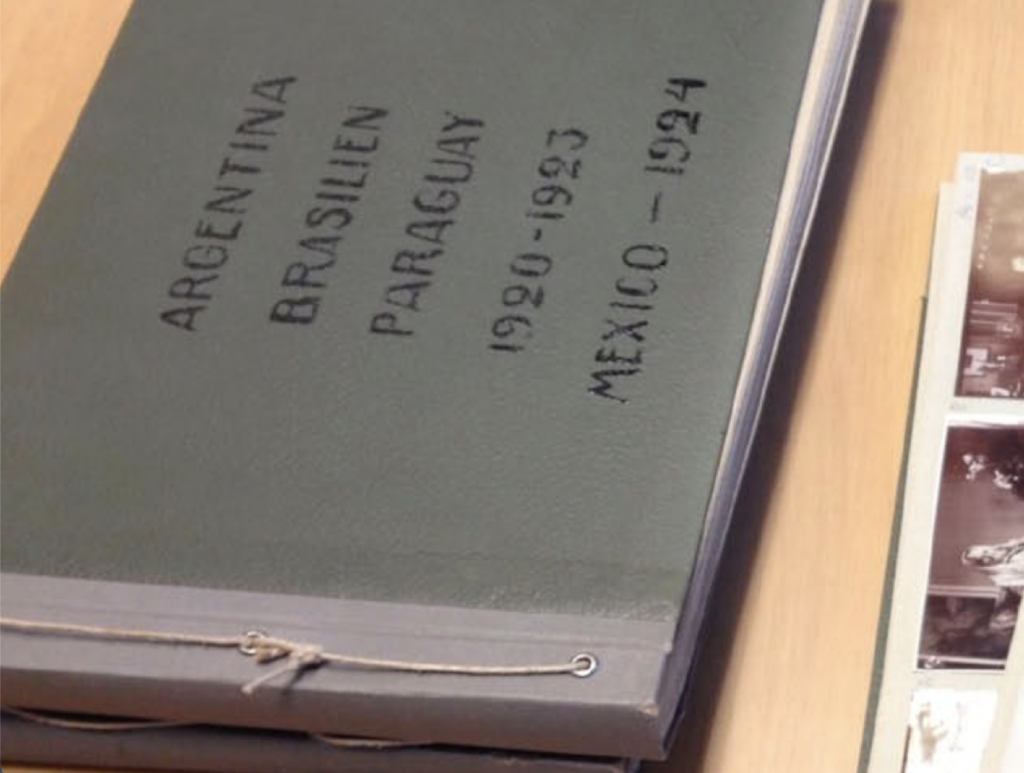
Above: Photo album of Bror Kronstrand.
The Story Told
As Åsa and I left the hotel that morning, we knew only one thing – this was the day we would finally encounter the bridge. But what would we find? Was it still standing, or had time reduced it to little more than hidden foundations? Would it still be possible to cross? These questions accompanied us as we set out, while we were still trying to absorb the previous afternoon’s extraordinary events. Karina had come running across the hotel to tell us that the Mayor of Fortín de las Flores wanted to meet us – immediately. Within minutes we had gone from sitting beside the swimming pool to standing in the municipal official building, where I gave an impromptu presentation explaining why I had travelled to Mexico, why I was searching for an abandoned railway bridge, and how it related to my research into the life and work of Bror Kronstrand. Before leaving we were photographed with the mayor beneath what we later jokingly called the city’s bell. We left the meeting with no more understanding of the walk towards the bridge.
Back to the day we travelled for, Karina and her mother met Åsa and me at the old railway station, Antigua Estación de Tren en Fortín de las Flores. Waiting there were municipal officials, a local reporter, a botanist, and several others who had volunteered to accompany us. What had begun as a personal search had quietly become a shared expedition. At the edge of the forest another group joined us. Åsa and I exchanged terrified glances as we realized they were heavily armed police officers. Why were they there? Someone quietly explained that cartel activity had recently been reported in the area and that the escort had been arranged for our protection. We were deep inside the forest, well beyond any point where Åsa and I could have found our own way back. The police officers, carrying automatic rifles, hardly looked at us. Their attention remained fixed on the forest, constantly scanning the surroundings. Suddenly our guide stopped and raised his hand. Instantly everyone froze. He quietly murmured a few words before lowering his hand and continuing as though nothing unusual had happened. Curious, I asked Karina what had taken place. After speaking with the botanist, she explained that the reporter, who was both documenting the expedition and guiding us through the forest, had simply asked the spirits for permission to pass that particular place. The incident was accepted as a natural part of traveling through the landscape. The dense canopy of the cloud forest filtered the sunlight, lowering the temperature and softening the harshness of the tropical morning. The botanist pointed out orchids, bromeliads, towering tree ferns, and countless unfamiliar species while I photographed everything around me. Although we walked together, everyone seemed absorbed in their own thoughts. Coming from Sweden, there was something profoundly unfamiliar about this landscape. The road gradually became a trail, and the trail dissolved into a narrow path winding through dense vegetation. Only afterwards did Karina tell us that the route had been cleared with machetes earlier that week simply to make our passage possible.
The first glimpse of the bridge came almost unexpectedly through the foliage, draped in mosses, vines, and decades of tropical growth. We approached in silence while the police asked us to wait before crossing. We did not know why. But this gave me time to search for a viewpoint that had occupied my imagination for years. In Bror Kronstrand’s private photograph album there is an image of this bridge taken from the train he was on more than a century ago. Kronstrand framed the train making a left turn. While still being in a car on the hillside the locomotive was center bridge. I looked for that same shot, carefully moving through the vegetation, I aligned the curve of the bridge, the ravine, and the surrounding trees until they matched the historic photograph as closely as possible. Standing there, I realized that I had found Kronstrand’s viewpoint. While the others prepared to cross, I remained behind for a moment. Looking through my camera, I realized that I had not travelled to Mexico simply to locate a forgotten structure. I had come to reconnect a photograph with the landscape from which it had once emerged. The bridge itself was beautiful but precarious. Sections of rail had disappeared, many of the wooden sleepers had rotted away, and narrow planks had been laid across some of the gaps. Looking down between the sleepers, the river shimmered some twenty metres below, making every step a deliberate decision. On the far side another group of police officers was waiting, a quiet reminder that we were about to cross invisible administrative boundaries. We got the clear signal to move on. Our experienced guide hesitated before stepping onto the bridge. Once he committed himself there was no turning back, yet halfway across he suddenly lost his footing and slipped between two sleepers. For a terrifying instant he hung above the ravine, supported only by his arms, two police officers reacted immediately and pulled him back onto the bridge. A long silence followed before anyone moved again, after which the crossing resumed with even greater care.
As we all reached the other side, spontaneously I recorded an interview with the Vía Verde specialist accompanying us. She spoke about the historical importance of the railway corridor, its remarkable ecological value, and the possibility of preserving abandoned railway lines as green corridors rather than allowing them to disappear completely. I was struck with a what if I missed out on a shot, and crossed back over the bridge to ensure myself I would not have missed a photo opportunity before returning back to the side of the ravine where everyone was waiting. As we continued towards Sumidero station, another 3 kilometers, the adrenaline slowly gave way to reflection. The bridge had existed for years for me only as a photograph preserved in an archive. For the locals as something without value. Now it had become a place we had reached together – explored, and crossed. Even so, disbelief lingered. It was difficult to accept that a journey which had begun with a single historical image had led us to this remarkable landscape, and that we had made it safely across. The Metlac Bridge – the forest has embraced the iron structure so completely that it no longer appears imposed upon the landscape but woven into it. Even when originally constructed, the railway followed the contours of the ravine instead of attempting to dominate them. Only a short distance away stands its modern successor: a high concrete highway bridge carrying cars, buses, and trucks across the same valley in a single straight line. It represents a different philosophy of infrastructure – one defined by speed, efficiency, and overcoming the landscape. The railway bridge, by contrast, bends with the terrain and seems to belong where it stands. Together the two structures reveal changing ideas of progress and different ways of imagining humanity’s relationship with nature. Approaching Sumidero station, the forest gradually gave way to traces of human presence – platforms, buildings, and the spaces where passengers had once waited for trains. A railway station is more than a building. It is a place of departures and arrivals, expectation and reunion. Memories lingering, making it easy to imagine the sounds that had once filled the valley: locomotives arriving, conversations between railway workers and passengers, and the daily rhythm of a railway that connected communities throughout the region. Only then did the significance of the journey fully settle. A route that had existed only as a photograph and a question preserved in an archive had become a landscape we had physically experienced. The bridge was no longer simply an image captured by Bror Kronstrand. It had become a place with sounds, textures, people, risks, and stories. Distances that had seemed impossible to judge within the forest suddenly became measurable. What had felt like endless wilderness was in reality a narrow corridor of extraordinary biodiversity preserved along the abandoned railway. The route from Fortín de las Flores to Sumidero was therefore not simply a walk through the cloud forest but a passage through layers of history. The railway had once connected communities across the mountains; after its abandonment nature had reclaimed the corridor without erasing its past. A century ago as Kronstrand crossed it symbolized connection, movement, and opportunity. Today many of Mexico’s railway corridors are associated with migration and hardship as people from Central and South America travel north aboard freight trains known as La Bestia—”The Beast”—in search of safety and a better future. The desire to move has remained constant, but the conditions surrounding those journeys have changed dramatically. History is therefore not simply a story of progress. Technology advances, societies change, and landscapes evolve, yet human hopes endure. I thought again about Kronstrand’s photograph. More than a century earlier he had recorded a fleeting view from a train without knowing that someone from the same Swedish town would one day return searching for the place where he had stood. I realized that the bridge had become more than the object of my research. It had become a meeting point between two artists separated by nearly a century yet connected through the same landscape and the same desire to understand the world through images.
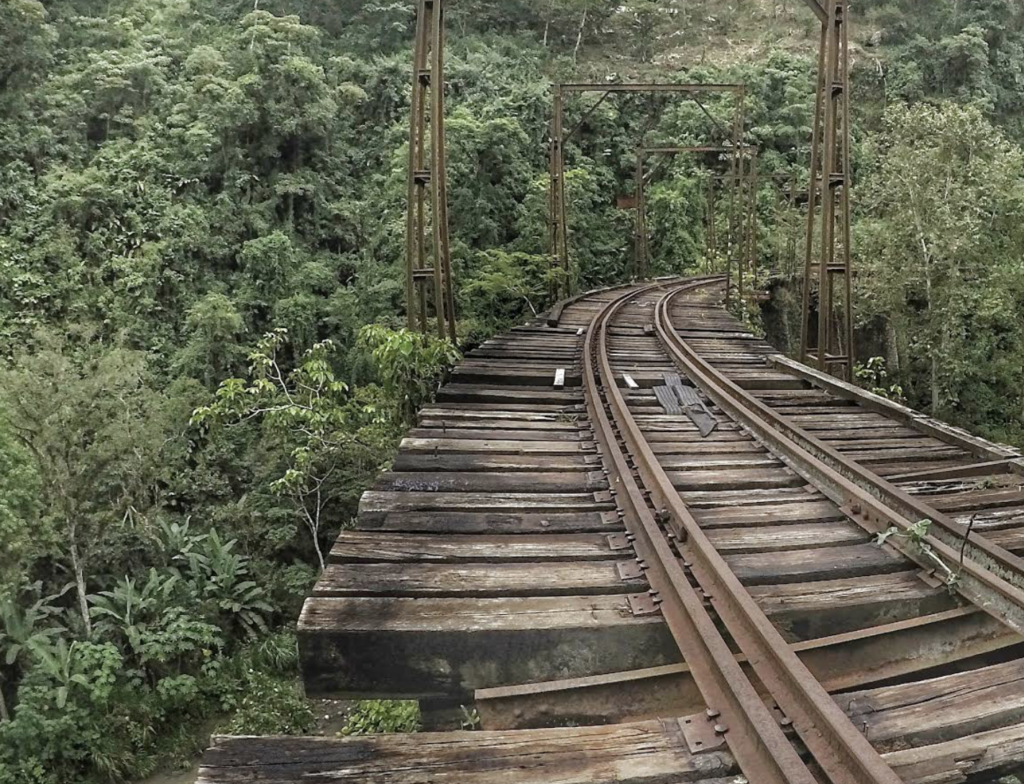
Above: A snapshot of the bridge in 2014.
The Liminal
The Metlac Bridge represents a remarkable encounter between engineering ambition and ecological complexity. Built as part of the Ferrocarril Mexicano, it was designed to overcome one of the most challenging sections of the railway route: the deep tropical ravine of Veracruz. Yet the solution chosen by its engineers was not simply to defeat the landscape but to work within its conditions. Under the direction of William Cross Buchanan, the railway alignment was adapted to the geography of the ravine, following a narrower crossing point rather than imposing an entirely artificial intervention upon the terrain. The bridge became a structure shaped by the landscape as much as by human intention. In this way, the Metlac Bridge represents a distinctive approach to 19th-century railway engineering: a structure that did not simply overcome nature as an obstacle but responded to the contours of the landscape. It stands as an example of how technology and geography could exist in dialogue, creating infrastructure that was both a human achievement and a continuation of the environment through which it passed.
The tropical montane cloud forest of the Barranca de Metlac has gradually transformed the abandoned railway into a living landscape. The iron structure is now surrounded by a dense ecosystem of tree ferns, orchids, bromeliads, mosses, lichens, and climbing vines. Epiphytes attach themselves to trees and surfaces around the bridge, drawing moisture from the humid air, while mosses soften the edges of the metalwork and vines weave through the remaining framework. The forest has not erased the bridge; it has incorporated it. This transformation reveals a different understanding of time. The bridge represents the speed and ambition of nineteenth-century industrial progress, a moment when technology extended human movement through previously difficult terrain. The forest represents a slower rhythm of growth, adaptation, and renewal. Over decades of abandonment, these two temporalities have met. The engineered structure and the living ecosystem now exist together, creating a hybrid landscape where industrial heritage and biological processes are inseparable.
Standing on the bridge, it becomes difficult to see nature and technology as opposing forces. The railway was originally built through the forest, carefully negotiating the contours of the mountains. Today the forest continues that negotiation, reshaping the railway through its own processes of growth. The result is neither a purely natural landscape nor a purely human one, but a place where architecture, ecology, and memory have become intertwined. The Metlac Bridge therefore offers more than an example of historical engineering. It reveals an alternative relationship between humans and the environment—one based not only on control and efficiency, but on adaptation, dialogue, and coexistence. The bridge survives because it has become part of the landscape it once crossed.
Crossing the Metlac Bridge changed the nature of my search. For years the photograph had been the destination, but once I stood there, the image gave way to the experience itself. The walk through the cloud forest, the uncertainty of the crossing, and the shared journey with those around us became the real discovery. The bridge itself became a liminal space where archive and landscape, past and present, imagination and lived experience briefly converged. It was here that experimental pilgrimage ceased to be an abstract research method and became an embodied way of knowing. The historical photograph had guided the journey, but it was the physical encounter with the place that generated understanding. Knowledge emerged not through observation alone, but through movement, uncertainty, vulnerability, and shared experience. Walking the route, feeling the humidity of the cloud forest, negotiating every unstable sleeper, listening to the forest, and sensing the presence of those accompanying us produced forms of understanding that could never be reached through archival research alone.
What struck me most was that the journey required multiple forms of trust. There was the obvious dependence on others: the local community who organised the expedition, the botanist who interpreted the landscape, the police who protected us, and the companions with whom we shared the crossing. Yet there were also other ways of knowing at work. Before entering one section of the forest, our guide paused to ask the spirits for permission to pass. No one questioned the gesture. It existed alongside the practical realities of armed protection and careful route planning. Scientific knowledge, local ecological expertise, spiritual practice, and concerns for physical safety were not presented as competing explanations but as complementary ways of inhabiting the landscape. Each acknowledged that the forest demanded respect.
The bridge itself embodied a similar philosophy. Built more than a century ago, it followed the contours of the ravine rather than attempting to erase them. Even after decades of abandonment, the structure appears to belong to the cloud forest. Mosses, vines, and trees have not concealed the bridge but entered into a long conversation with it. Nearby, the modern highway bridge expresses a different understanding of progress. It spans the valley in a direct line, overcoming the landscape through height, speed, and efficiency. The older railway bridge, by contrast, negotiates with the terrain. It accepts the ravine instead of denying it. This contrast extends beyond engineering. It reflects two fundamentally different relationships between humans and the world they inhabit. One seeks to dominate obstacles by reducing distance, straightening routes, and maximising efficiency. The other accepts that movement is shaped by the landscape itself and that progress can emerge through adaptation rather than conquest. The railway bridge does not encompass nature; it works with it.
Experimental pilgrimage is grounded in this second understanding. It is not simply a method for revisiting historical places but a way of entering into dialogue with them. Rather than treating landscape as the passive setting for historical events, it recognises place as an active participant in the production of knowledge. Walking becomes a research practice because it exposes the body to the same gradients, distances, sounds, uncertainties, and material conditions that shaped earlier journeys. The aim is not to recreate the past—that remains impossible—but to create the conditions in which new understandings can emerge through embodied encounter. Seen in this light, the Metlac Bridge was never simply the destination. It functioned as a threshold between different modes of knowing: archival and experiential, analytical and sensory, historical and contemporary, scientific and spiritual. Crossing it required attention not only to documents and photographs, but also to the people who knew the forest, the risks that still inhabit it, the rituals that continue to give it meaning, and the material presence of a structure that has learned to exist with its environment rather than against it. The experimental pilgrimage therefore did not end when the bridge had been found. It began the moment the archive ceased to be the primary source of knowledge and the landscape itself became the text to be read. That shift—from representation to encounter, from looking to walking, from evidence to experience—is perhaps the most valuable insight the journey offered.
Facts about the Metlac bridge
The Metlac Bridge formed part of the Ferrocarril Mexicano (Mexican Railway), the ambitious 19th-century railway connecting Mexico City with the port of Veracruz. The line was officially inaugurated on 1 January 1873 after 36 years of construction, representing one of the most significant engineering achievements of its time. Located between the former railway stations of Sumidero and Fortín de las Flores in the state of Veracruz, the bridge crosses the Barranca de Metlac (Metlac Ravine), one of the most challenging sections of the entire route due to its steep tropical terrain.
The ravine, approximately 115 metres deep and 275 metres wide at its broadest point, demanded an innovative engineering solution. The Metlac Bridge was not the work of a single architect but the result of a collective engineering vision led by William Cross Buchanan. His decisive contribution was recognising that the landscape itself offered the solution. Rather than imposing a monumental structure across the full width of the ravine, the railway alignment was adapted to the geography, following a narrower crossing point and allowing the bridge to become a negotiation between human ambition and the mountainous terrain.
***
Making The Immortal
The project started in the summer of 2011 as Anna Viola Hallberg stumble over some peoples excitement over a local painter Bror Kronstrand (1875-1950). Both of them born and rased in Mariestad, Sweden. To work with the project artist Björn Perborg was invited and the two of them went to a medium in Gothenburg to reach out for Kronstrand him self. The project carried out is a free standing essay film in addition to a video, text, photography and sculpture installation both with the name Making The Immoral. >>>
***
The Research
Kronstrand had arrived at the port of Veracruz and continued his journey by train towards Mexico City. Looking at the photograph, I became convinced that I needed to locate the bridge. Over time, the search developed into an obsession, and perhaps I even fell in love with the beauty of the place before ever seeing it.
In the photograph, Kronstrand is leaning out of the window on the left side of the train as it crosses a ravine. From the middle section of the train, the curve of the bridge allows the viewer to see the locomotive disappearing towards the front. Below, wild water cuts through the landscape, while tall pine-like trees rise towards the sky. The slopes of the ravine are extremely steep, almost vertical, creating a dramatic encounter between engineering and nature.
The engineers who designed the bridge had to respond to this difficult terrain, allowing the railway to descend on one side of the ravine and rise again on the other. Even at the centre of the bridge, the track remains more than twenty metres above the river below. Kronstrand’s photograph captures the exact moment when all elements come together: the elegance of a carefully designed railway structure, the movement of the train, and the extraordinary landscape surrounding it.
At the beginning of my search, locating the bridge was far from straightforward. Extensive research through online archives, maps, and databases was not yet possible in the way it is today. This was between 2011 and 2013, before the ability to instantly locate almost anything online had become normal, both in Sweden and Mexico. I was not even certain whether the bridge still existed or where exactly it had been located.
Fortunately, during my studies in museology at the University of Gothenburg, I had become friends with a fellow student from Mexico City, Karina Ocaña. Through her connections, we eventually reached an organisation working to transform abandoned railway routes into Vía Verde (greenways). This became the first real possibility of approaching the bridge.
Looking at maps today does not fully communicate the experience of reaching the bridge. The route appears simple and accessible, but the reality was completely different. My assistant Åsa Öhrn and I felt as if we were entering a remote forest, approaching a hidden treasure. We were accompanied by eight or nine heavily armed police officers, a biologist, a local newspaper reporter, and a trail guide who was also a spiritual guide. The municipality had cleared the path only the week before our arrival in order to rediscover a forgotten part of their own history.
The journey itself became as important as the destination. Walking through the cloud forest, surrounded by extraordinary vegetation and guided by people with different forms of knowledge, transformed the search from a historical investigation into an embodied experience. The bridge was no longer only an image from an archive; it became a place that demanded to be approached physically, emotionally, and respectfully.
At the time of my departure in early February 2014, there was extensive media coverage in the United States concerning Mexican railways and migration. Mexico no longer had a passenger railway system; it had largely been replaced by an extensive network of bus services. What remained was the freight railway system, which had become associated with migration routes and was often referred to as La Bestia (“The Beast”), also known as El Tren de la Muerte (“The Train of Death”) or El Tren de los Desconocidos (“The Train of the Unknowns”). These trains carried thousands of migrants travelling northwards in search of a different future, transforming the meaning of the railway from a symbol of connection and progress into one associated with danger and uncertainty.
The abandoned railway bridge therefore existed between several histories: the era of exploration and connection that Kronstrand documented, the industrial ambition that created the railway, the ecological transformation that followed its abandonment, and the contemporary realities of migration that continue along Mexico’s railway networks. The journey to the bridge became not simply a search for a location, but a passage through different layers of time, memory, and human movement.