WAKING AND THE ARTS
Conviction gives direction, while uncertainty keeps perception open. Between them lies the space of artistic inquiry: a place where one can act with commitment while remaining receptive to what is unknown. /AV
For many years I had my walking and I had the arts. First from 2020 they started to be entangled as I embarked on living five years in rural Stockholm Archipelago. Below are walks that has formed my thinking and artistic practice. Most of them intandem with one other person.They are presented in random order in three categories: artist – personal/experimental pilgrimage, curatorial – project for others and public presentations/texts. The listing below is select and walks are being added.
Statement:
My practice occupies a space where personal pilgrimage and experimental pilgrimage intersect. I approach walking as both an intimate, embodied experience and an artistic methodology through which I investigate place, movement, memory, and relationships. For me, walking is not simply a way of moving through a landscape; it is a way of listening, sensing, and entering into dialogue with the environments and beings I encounter.
I understand pilgrimage as a process rather than a destination. My work does not seek a predetermined arrival or a fixed spiritual resolution, but instead explores states of attention, vulnerability, and openness. Through walking, I create conditions for encounters to unfold—between body and landscape, memory and place, self and other. The personal becomes a point of departure for broader investigations into how we inhabit and relate to the worlds around us.
Within my practice, experimental pilgrimage becomes a way of questioning inherited ideas of pilgrimage and expanding its possibilities through artistic research. My walks are shaped through observation, repetition, improvisation, and responsiveness to place. Rather than following established routes or rituals, I allow the landscape itself to participate in the process. Walking becomes a method of inquiry through which meaning emerges gradually, through time, movement, and attention.
My Experimental Pilgrimage works explore how embodied experience can produce knowledge. I investigate how the body encounters landscapes, how movement carries memory, and how walking can create relationships between human and more-than-human worlds. Through walking scores, documentation, performative actions, and reflective processes, I use experimentation not as a departure from personal experience but as a way of deepening it.
I understand walking as simultaneously a method, a medium, and a form of research. In my practice, personal transformation and artistic experimentation are inseparable; they continuously shape and inform one another. The act of walking becomes an embodied inquiry where place, time, memory, and presence are constantly negotiated.
Through Experimental Pilgrimage, I explore pilgrimage as a contemporary artistic practice grounded in attentiveness, relationality, and embodied knowledge. My work invites slower ways of perceiving and inhabiting the world, opening possibilities for connection, care, and renewed relationships with the landscapes through which we move.
Walk With Me
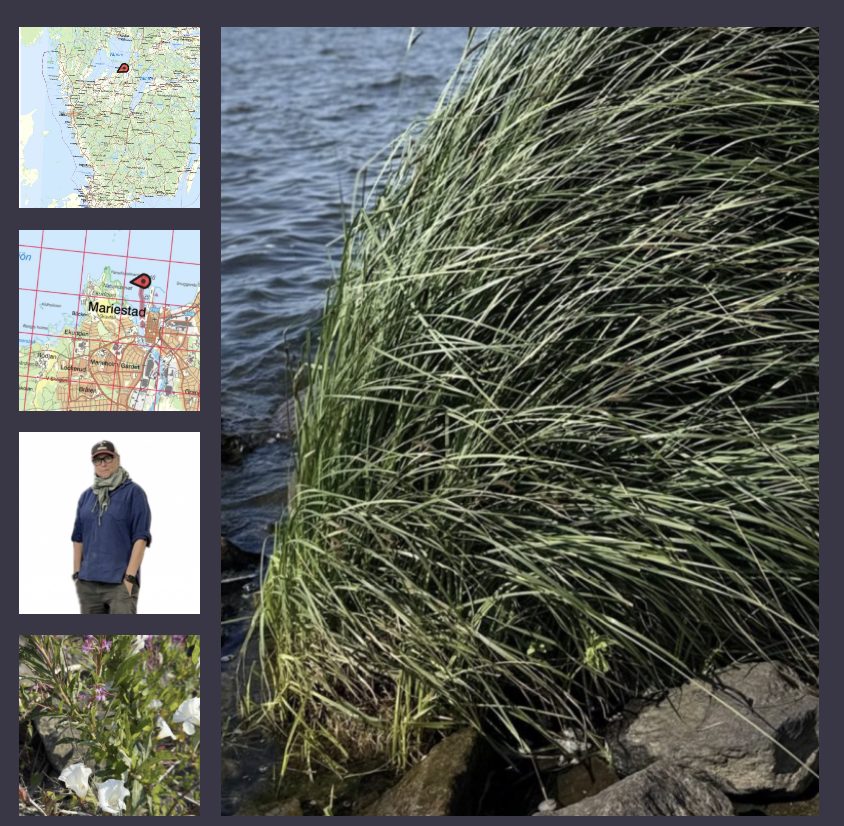
A transitional walk was developed as a public art walk for the pier in harbor of Mariestad, Sweden. This work was developed as part of a keynote presentation on Infrastructures and Freedoms, Rurban Talks. It’s a liminal walk in a specific site but can be walked with good imagination anywhere. (Sweden, 2026) >>>
Wakayama Prefecture
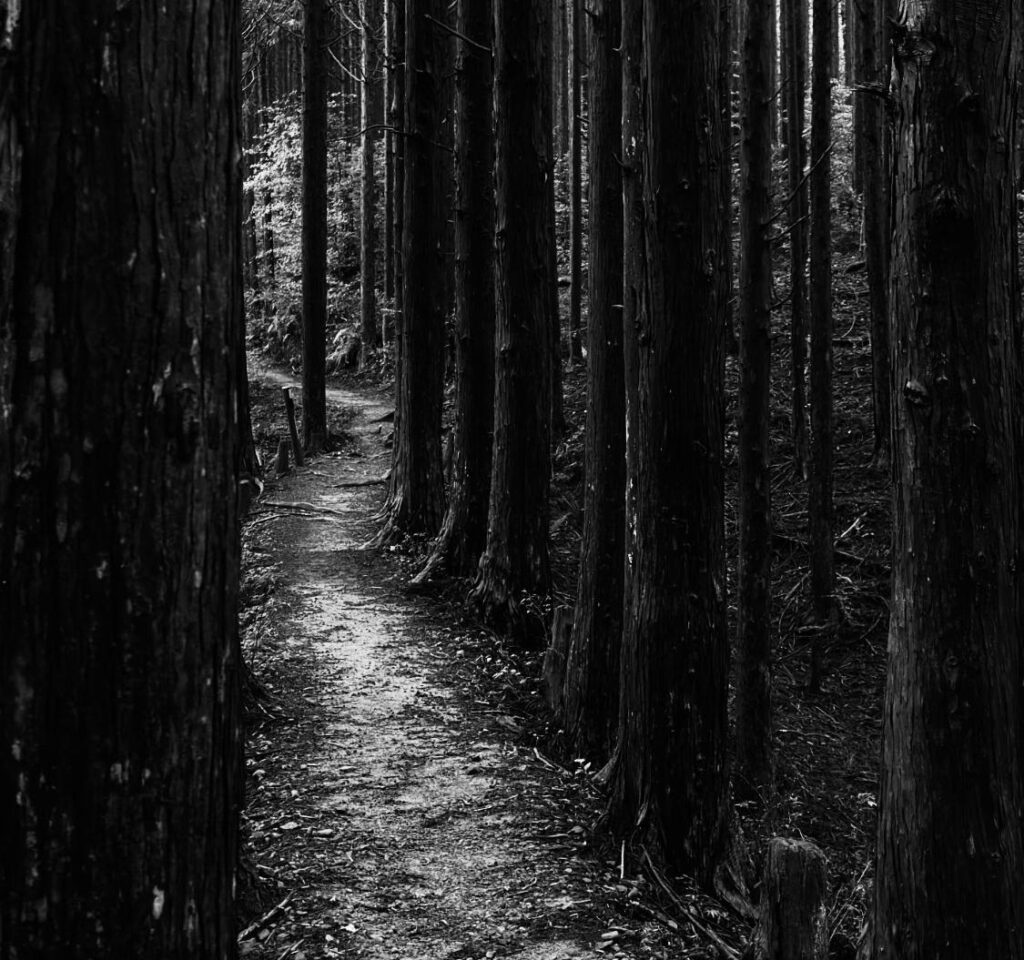
After living in and developing a relationship with the Swedish forest landscape, I was drawn to the forests of Wakayama Prefecture and the ancient pilgrimage routes of the Kumano Kodō. For over a thousand years, these trails have connected the sacred Kumano Sanzan shrines through a tradition blending Shinto, Buddhism, and mountain asceticism, where the presence of ancestors is continually invoked. By Berg Duo (Japan, 2024)
This joint work we work on separately as we turn them in to walking arts projects. (wip)
Atravesando la barranca
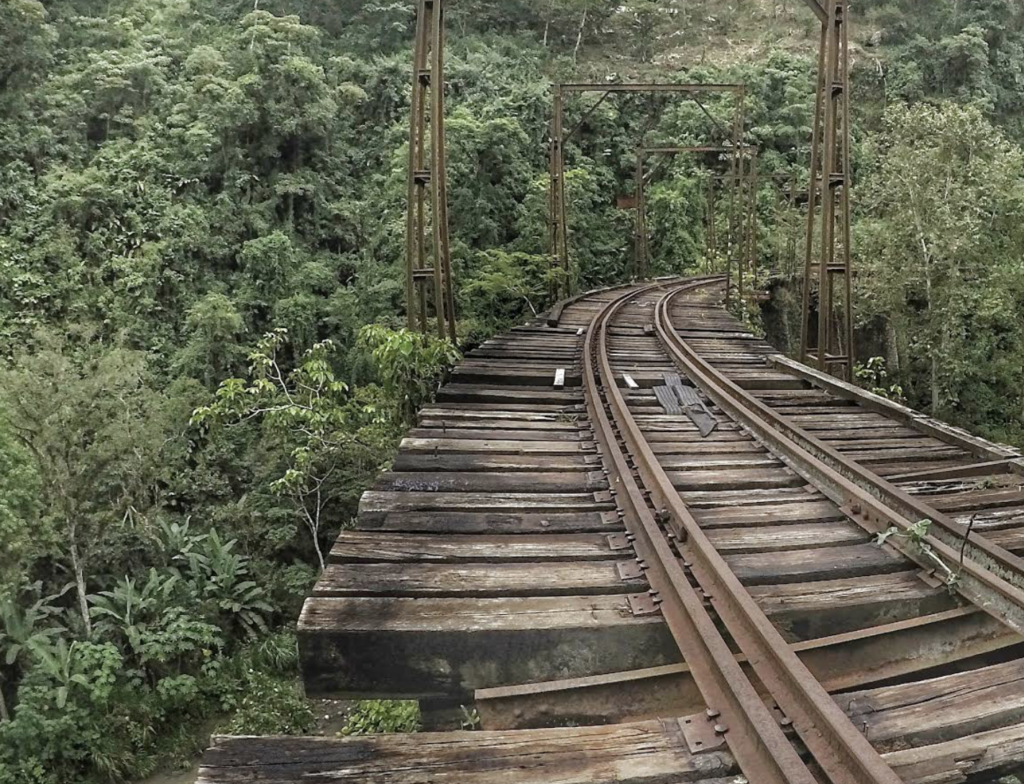
This work is conceived as an experimental pilgrimage. It began with the discovery of a photograph of a bridge in the collection of a public library. The image prompted a process of research that unfolded into a physical journey, culminating in a walk to the bridge traversing the ravine. Antiguo Puente del Ferrocarril de Metlac in Mexico was revisited. The tittle of the walk is Bridge of the Unknowns (Mexico, 2014) Fore more >>>
We just walk
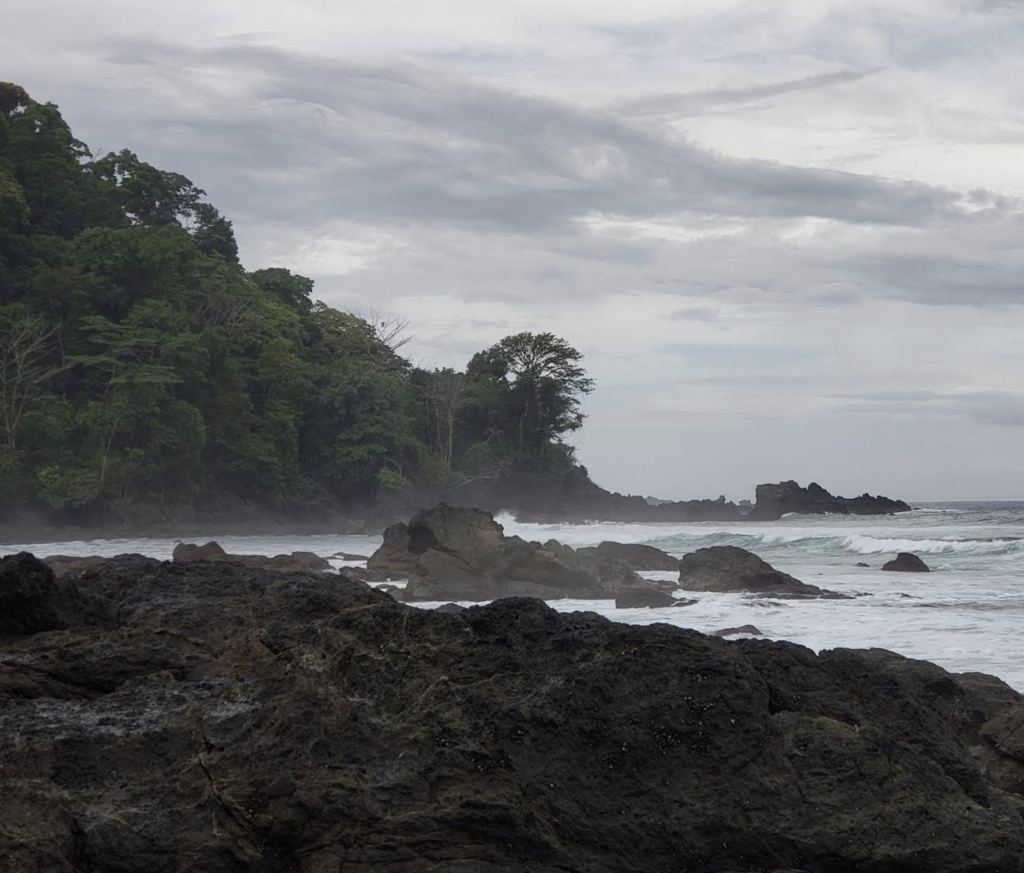
Costa Rica called, and we answered. We flew from New York to San José with one destination in mind: the Osa Peninsula.
The journey took place at a particular moment in time—after the internet had become an indispensable research tool, but before constant connectivity had erased every unknown. We could plan flights, read travel accounts, and search for practical information before leaving home, yet there were still blank spaces. The Osa Peninsula remained one of them. Detailed maps were surprisingly difficult to find, satellite imagery was limited, and once inside the rainforest there would be no cell phone coverage, no GPS, and no way to check whether we were headed in the right direction. We were drawn precisely to that absence.
read more
The trip also marked a pause in another body of work. For an extended period, we had been working within the queer community in Saint Petersburg, Russia, making photographs and building close relationships with people whose everyday lives unfolded under increasing political and social pressure. The work demanded complete immersion. It was emotionally intense, shaped by conversations, trust, and the responsibility of representing lives that were often made invisible.
We realized we needed distance—not from the work itself, but from the emotional weight of constantly being present for other people’s stories. We longed for somewhere warm, coastal, and disconnected. Somewhere where the landscape, rather than human society, would become our primary conversation partner.
Before leaving Sweden, I spent weeks trying to find a map of the Osa Peninsula. I searched bookstores, libraries, travel shops, and online catalogs without success. During our layover in New York, the search continued. We found camping equipment and everything else we needed for the expedition, but still no map.
Arriving in San José, we assumed it would be easy to find one. We spent several days adjusting to the tropical climate while searching the city, yet every attempt ended the same way. No map. Eventually, we boarded the fifteen-hour bus to Puerto Jiménez, convinced that surely the gateway to the peninsula would have what we needed.
Instead, we arrived to a town without electricity. A tropical storm had just passed through, leaving the region in blackout. Government offices and businesses were closed. We were told to return in three days.
So we waited.
We walked out of town and pitched our tent on a small stretch of rocky beach, living simply while the town slowly recovered. When the offices reopened, we returned to ask once more for a map.
There still wasn’t one.
At the ranger station we explained that we wanted to hike through Corcovado National Park for several days. We obtained the necessary permits but declined a guide. What we really wanted was a map. Someone disappeared into a back room and eventually returned with a photocopied sheet of paper bearing a rough hand-drawn sketch. It wasn’t really a map. It was a memory of one.
We accepted it.
At the trailhead we unfolded the paper and guessed which faint line marked the beginning of the path. That uncertainty became our method. We reached the first campsite without seeing another person. The next morning we followed the sparse directions until the trail divided. Left or right? There was no way to know. We assumed both paths must eventually reconnect, perhaps rerouted after heavy rains. We chose one and kept walking.
For days there was no phone signal. No internet. No reassuring blue dot telling us where we were. Navigation became a matter of paying attention. We learned to read rivers, coastlines, animal tracks, changes in vegetation, and the rhythm of the terrain. Every decision required observation rather than verification.
Monkeys threw sticks at us from the trees. We crossed rivers that changed with the tides. We watched for snakes beneath our feet and listened for sounds we could not identify. We kept walking.
By the end of the second day we reached Sirena Ranger Station and pitched our tent on a wooden platform among the tents of biological researchers. They studied snakes, bats, insects, and rainforest ecosystems. Curious, they asked what our research project was.
“We’re artists,” we answered. “We’re from Sweden.”
The response felt strangely inadequate, but it was the truth.
Looking back, the journey became a reflection on the limits of research. We had prepared as thoroughly as possible, yet preparation eventually reached a point where it could take us no further. Beyond that point lay uncertainty, and uncertainty demanded commitment rather than more information.
Today it is increasingly difficult to imagine traveling without constant access to maps, recommendations, reviews, and satellite imagery. Every destination seems pre-experienced before arrival. Algorithms promise efficiency, predictability, and reassurance. Yet they also reduce the possibility of genuine discovery.
This journey belonged to a brief transitional moment, when digital research was available but not yet complete, when parts of the world still resisted total accessibility. The missing map was not an inconvenience; it became the work itself. It forced us to rely on observation instead of instruction, intuition instead of optimization, and trust instead of certainty.
Our interest has never been in adventure for its own sake. It is in the creative potential that emerges when certainty disappears. The moment when the research is finished, the map runs out, and there is nothing left to do but continue. That threshold—between knowledge and the unknown—is where we feel most alive, and where our artistic practice begins.
Co-walker: A Karlsson Rixon
People from the south, and people from the north
This work began with a simple question: Could a song replace a digital map?
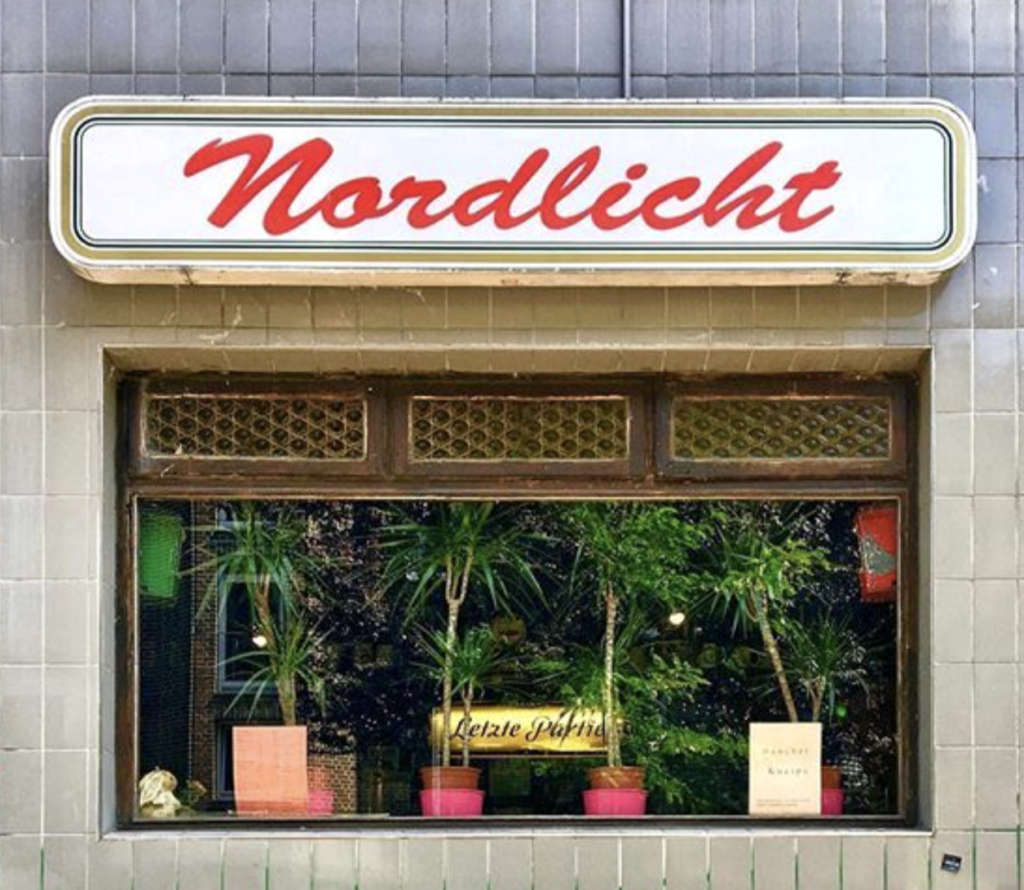
My brother and I have always shared a love of music, and one song kept coming back to us: Nordlicht by the Swedish band Sällskapet. The more we listened, the more the lyrics sounded like directions rather than a song. We began to wonder whether they could actually guide us through a city.
So we traveled from Stockholm to Hamburg, leaving behind GPS, digital maps, and online recommendations. Instead, we followed the lyrics as a walking score. To our surprise, they worked. Step by step, the song led us to the 24-hour bar Norderlicht.
Finding the bar was never the point. What mattered was rediscovering a way of navigating through storytelling rather than technology. The journey became an experiment in trusting a shared narrative instead of an algorithm, allowing us to experience the city through memory, language, and sound rather than a screen.
The neighborhood also echoed the Hamburg portrayed in Anders Petersen’s photographs from the late 1960s. His images captured sailors and stokers from around the world alongside merchants, dockworkers, cabdrivers, sex workers, striptease dancers, pimps, poets, petty criminals, and other night revelers—people who were often given the cold shoulder by what was considered “respectable society.” The song evokes a similarly diverse community, singing of “people from the south, people from the north,” all gathering within the same urban landscape.
This project explores what happens when music becomes a map, lyrics become directions, and a city is discovered through shared stories instead of digital navigation. It asks whether storytelling can still shape the way we move through the world, even in an age of instant maps and algorithmic recommendations.
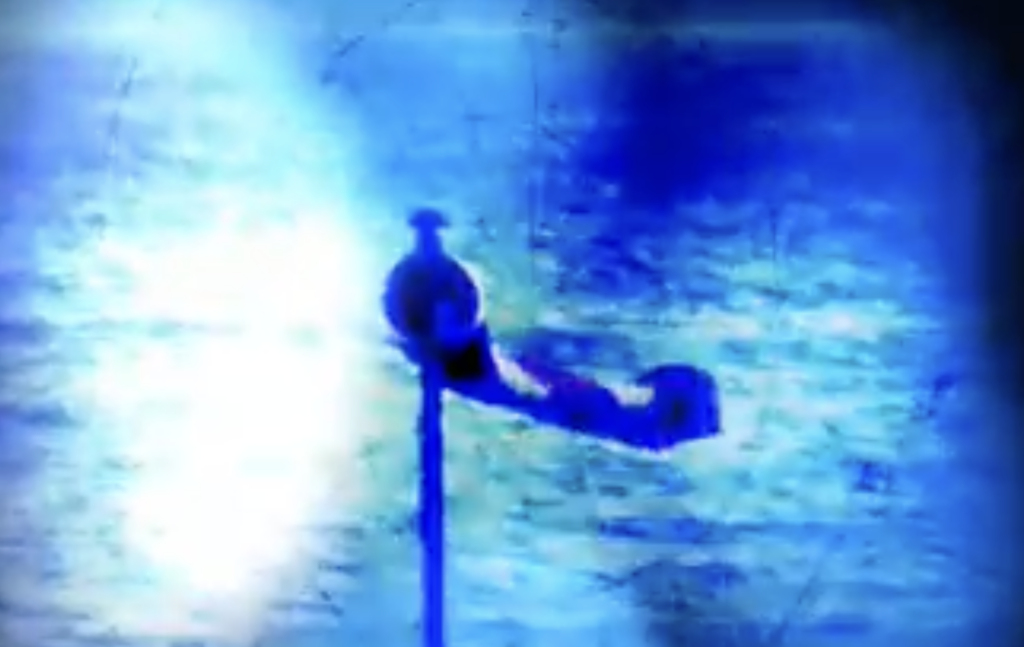
Video of original song >>>
Speechless Walk
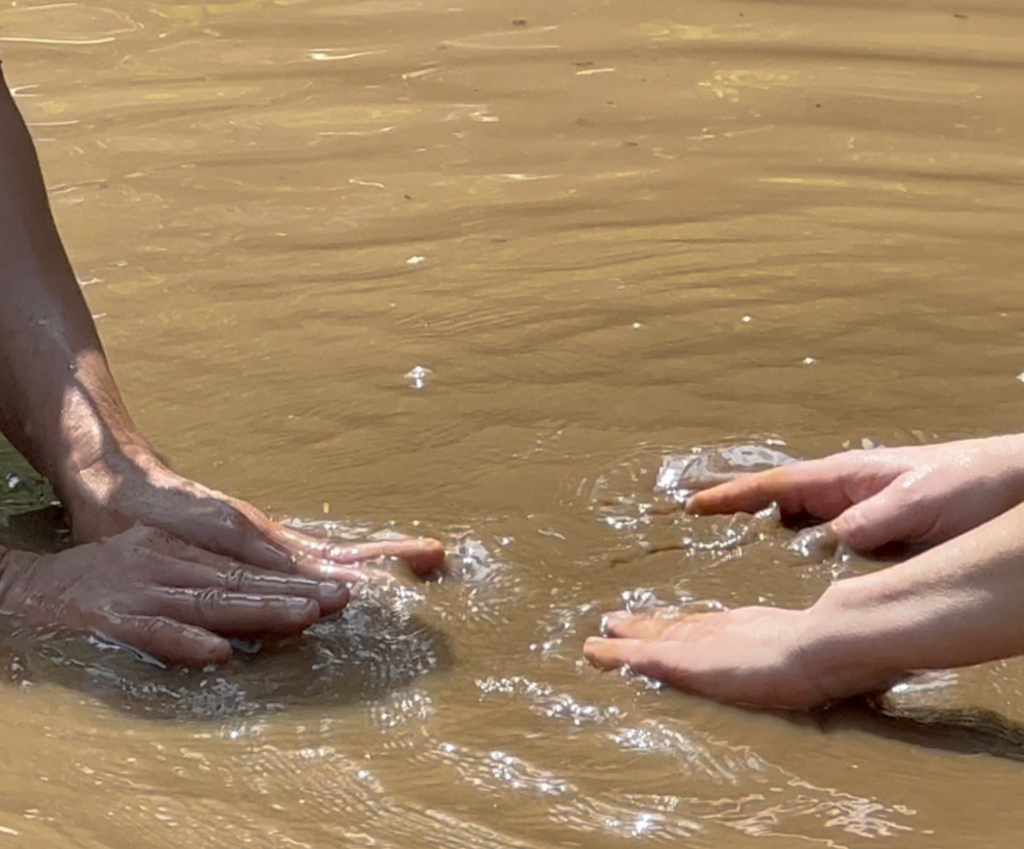
A walk in the village Ciganitri, West Java and its survival water levels and Bandungs gentrification. “Working at the intersection of lens and embodied practices – we are interested in movement and space within and beyond language, and ask how movement can bring spaces together, and how several spaces can be made into one, through embodiment. As time collapses, space is put at the forefront of our artistic research”. The walk was a speechless, undirected interaction between two dancers and a camera, generating video material.used in other art works. By Berg Duo. (Indonesia, 2023)
Once
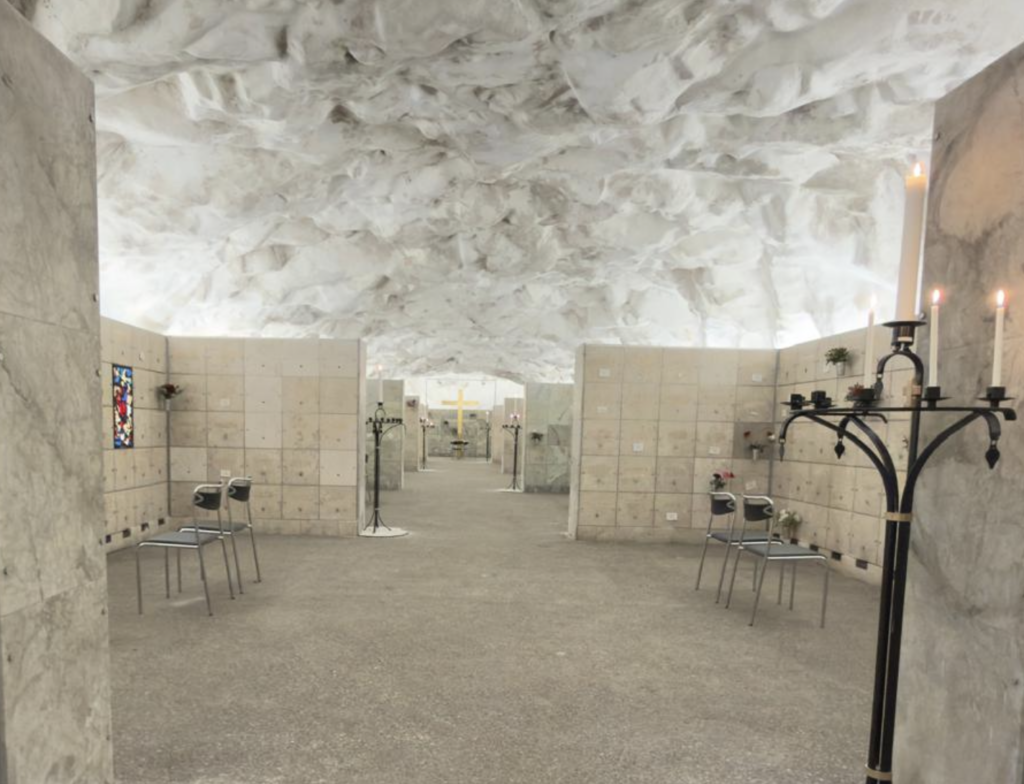
A memorial walk in four Stockholm Columbarium. In memory of fellow walkers. A public walking score of grief. The word columbarium comes from the Latin columba, meaning “dove,” because the rows of niches resemble the small nesting compartments of a dovecote. (Sweden, 2025-26) >>>
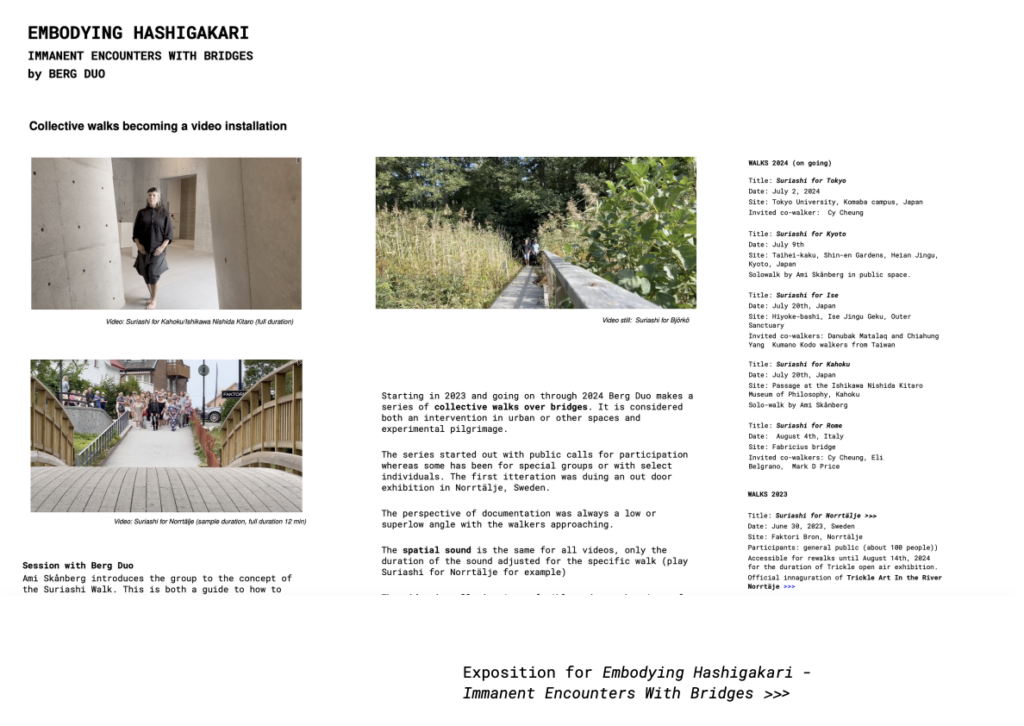
Embodying Hashigakari
Collective bridge crossings as immanent encounters with bridges. The walks resulting in a video installation. Suriashi led by Ami Skånberg as collective practices. By Berg Duo. (Sweden, Germany, Japan and Italy, 2023-24) >>>
Curatorial Initiatives
WAP26
Walking The Archipelago , Drifting as a nomadic state
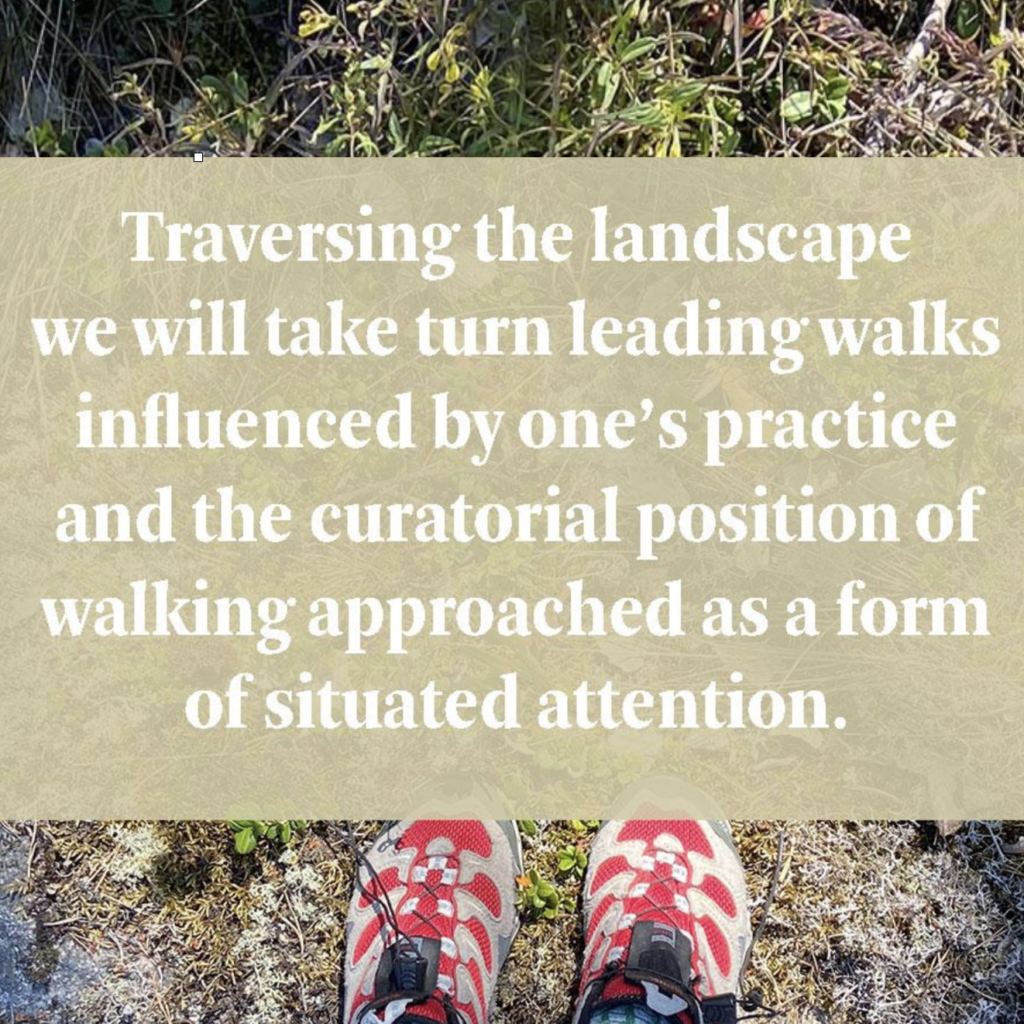
August 2026 we are set to traverse the landscape we will take turn leading walks influenced by one’s practices and the curatorial position of walking approached as a form of situated attention – an embodied way of encountering territory, history, and power under conditions of rupture and uncertainty. Together we unpack Entanglement and Proximity towards social imagination. The walk puts us in a state of walking with conviction hence many factors are uncertain. (Sweden, 2026-) >>>
Walk With Us
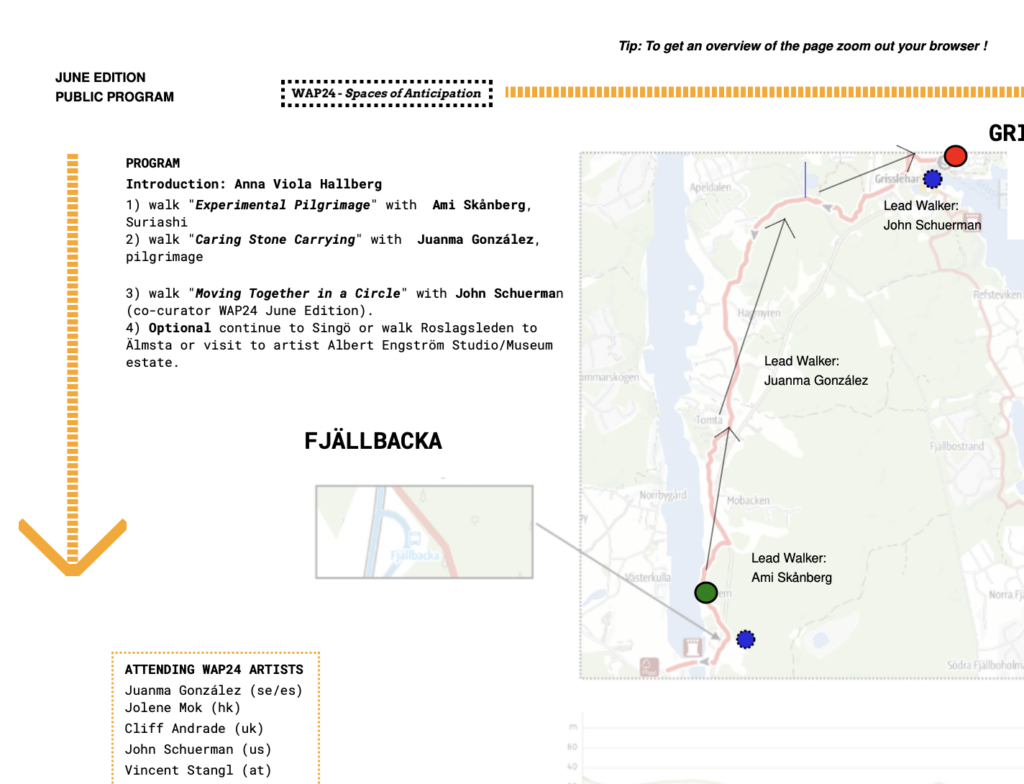
This collective walk on experimental pilgrimage was curated by Anna Viola Hallberg. Sequences were led by Ami Skånberg, Juanma Gonzalez and John Schuerman it was open for public participation and is set on a pilgrim path. It was a special project with in WAP24. (Sweden, 2024) >>>
Walking As Practice 2023-25
In this context, walking is treated simultaneously as an artistic medium and as a methodological framework for critical and creative investigation. As artists move through lived environments, they explore how agency may be extended to human and nonhuman others, to place, and to ecological processes. These practices emphasize relational care and collective attunement as strategies for cultivating co-presence and emergent forms of togetherness as social imagination. (Sweden, 2023-) >>>
WAP23-25 on Research Catalogue >>>

Cohort & Walking Words
Walk Talk and Text
Walking Talking Pod Cast >>>
Islands as Stepping Stone >>>
WAPC
Walking As Practice Cohort
WAPC artists have an interest in traversing and transgressing through spaces and in this process rethinking and critiquing the social and ecological systems and structures we inhabit. WAPC engage walking as an art practice and as a methodology for critical creative inquiry. While in motion, each artist is examining ways to extend agency to others, place and the more-than human through acts of relational care and as a strategy for building togetherness.
WAP Cohort / WAPC >>>

Projects with/by Anna Viola Hallberg
* * *
Walking Arts and Transience as Position
Transience as Artistic Approach
Transience is central to the project’s artistic approach, understood not simply as movement through space, but as a method for engaging with instability, displacement, and incompleteness. By moving away from fixed geographic anchoring toward a nomadic mode of practice, transience becomes both an epistemic method and an aesthetic stance.
Within this framework, walking functions as a tool for dwelling in the temporary, the fragmented, and the situated. Knowledge emerges not linearly but through movement, interruptions, encounters, and shifting relations between body, place, and collective.
In blue spaces, this approach gains further resonance. The mutable, elusive qualities of water environments—their rhythms, dissolving boundaries, and constant spatial transformations—reflect and activate transience as an artistic principle. Here, the landscape becomes a co-actor rather than a backdrop, shaping a process defined by openness and uncertainty.
Transience also carries critical and political dimensions. By emphasizing movement, impermanence, and provisionality, the project challenges conventional notions of stability, ownership, and territorial control. Proximity is reframed as an ethical, situated relation in which participants and landscape engage under conditions of mutual dependency and vulnerability.
The project’s artistic significance lies in consistently working with transience as both method and content. Walking produces situated, embodied, and relational knowledge—always partial, always in flux. In doing so, the project contributes to the renewal of walking art, formulating a practice where the temporary and unpredictable are not limitations, but essential artistic qualities.
Transience as Method and Artistic Strategy
Transience lies at the core of the project, functioning simultaneously as a methodological and artistic principle. Methodologically, it is a mode of engagement with instability, displacement, and incompleteness: knowledge emerges not linearly, but through movement, interruption, and situated encounters between body, place, and collective. Artistically, walking becomes a medium that embodies temporariness and relationality, with landscapes—particularly water environments—acting as co-creators rather than mere backdrops. This approach embraces unpredictability and openness as aesthetic assets, challenging conventional ideas of mastery, ownership, and control. By integrating transience as both process and content, the project produces embodied, relational, and context-sensitive knowledge, contributing to the renewal of walking art and establishing proximity and impermanence as central ethical and artistic qualities.
Co-Becomings
This selection of walks is less about arriving at a sacred destination and more about using the act of journeying as an artistic method for exploration, transformation, and meaning-making. It sits at the intersection of walking, performance, installation, social practice, and conceptual art, often blurring the boundaries between everyday life and artistic experience. In some cases it is about a specific site or walking it as part of a long desire and engaging with it towards co-becomings. The works are made as collective efforts, collaborations, participatory or solo walks. Walking art is a contemporary artistic practice where the act of walking is the central medium, experience, or outcome. Instead of producing traditional static objects like sculptures or paintings, artists use their bodies moving through a landscape to explore environments, engage in political activism, or create ephemeral mark-making and storytelling.
The headlines below are in some cases the title of the project (italicized) in others an introductory phrase. They are performed by artist/curator Anna Viola Hallberg. They are introduced n a random order, but starting out with works as an artist and later including curatorial orchestrations.